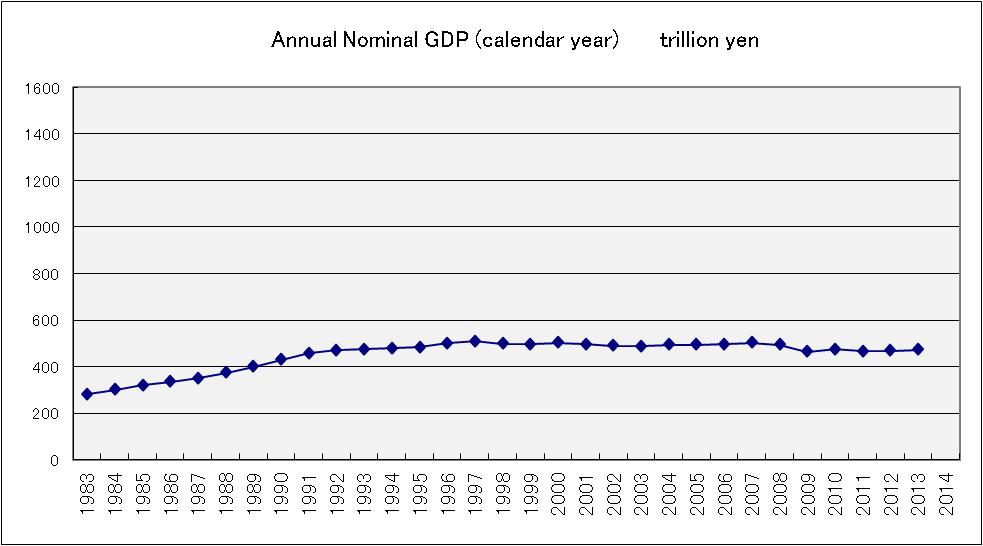
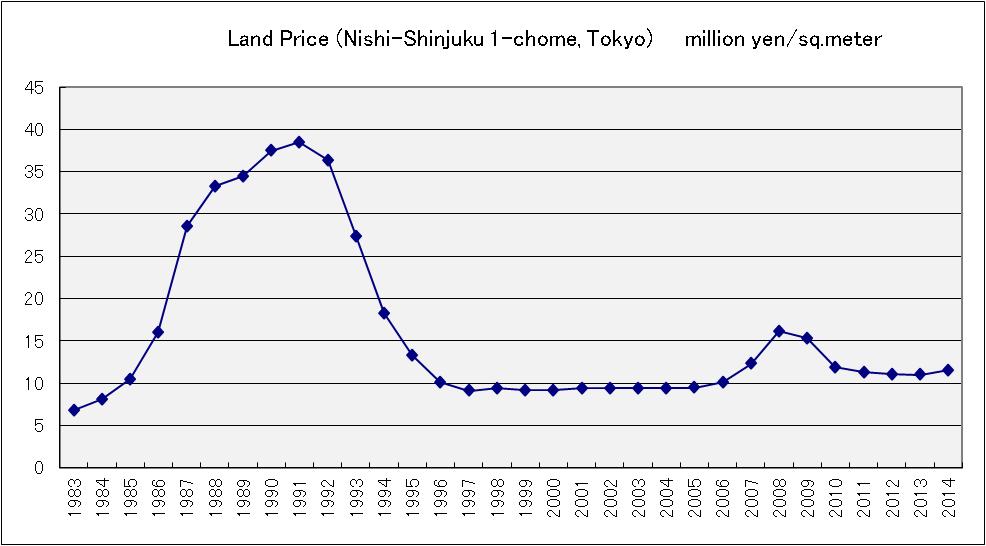
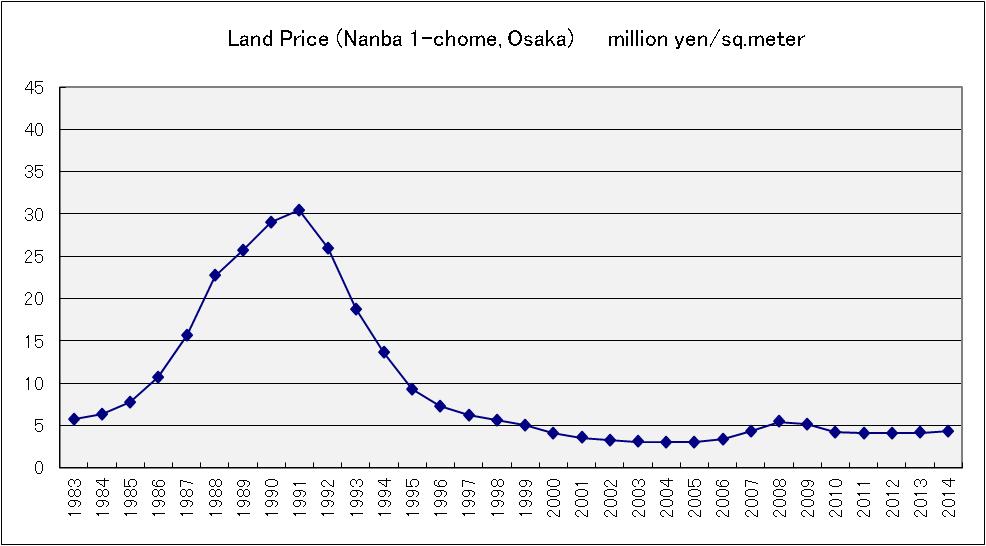
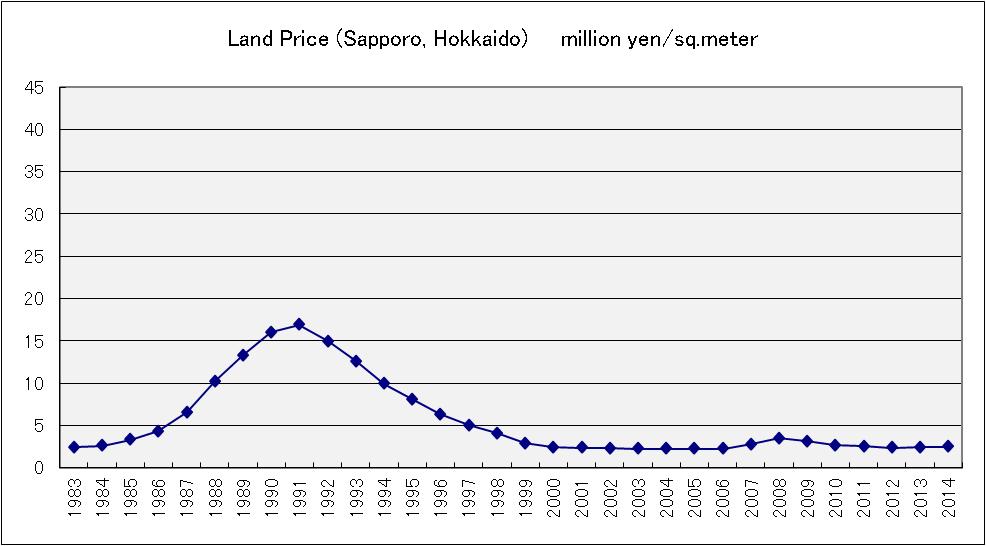
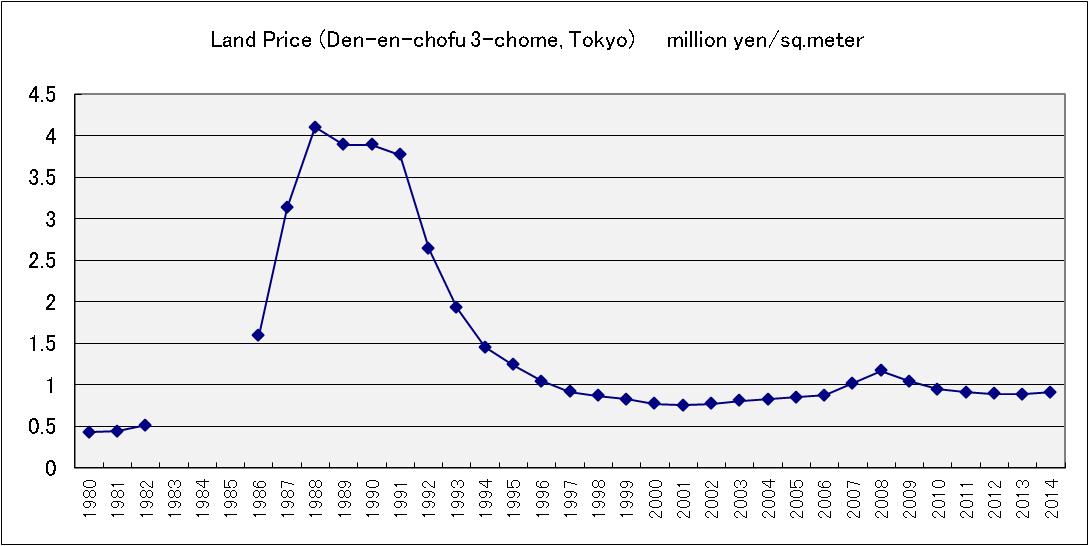
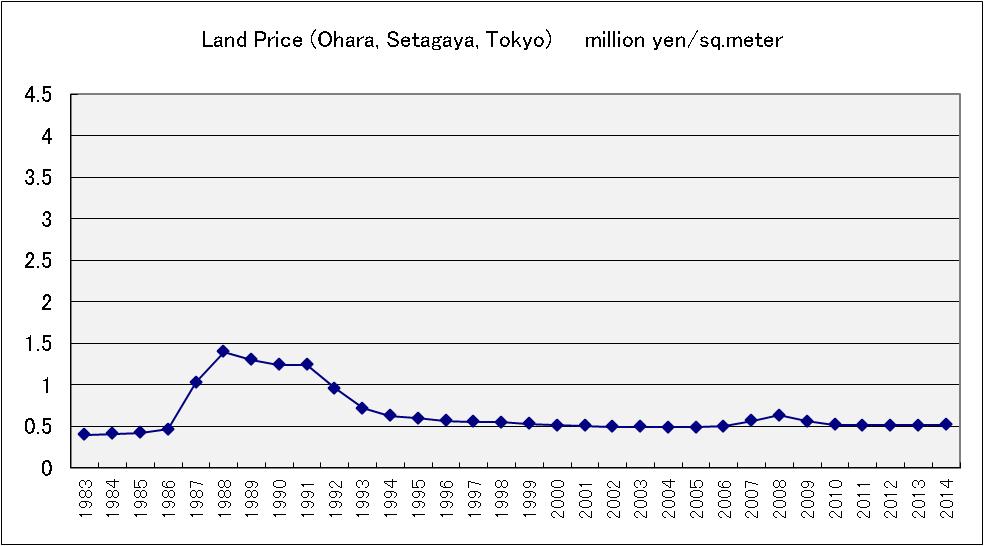
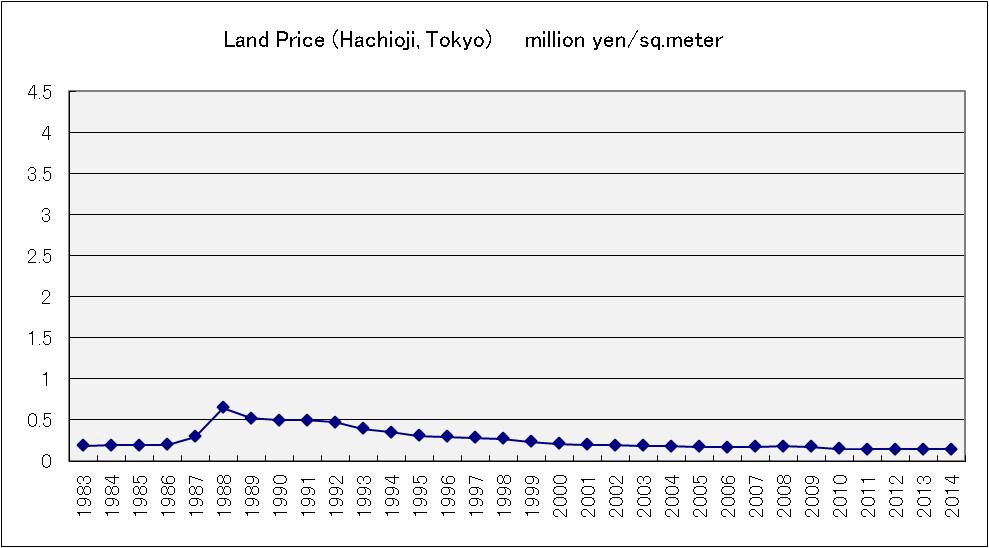
| It is now bottoming out ! Tokyo land price ends fall Notes: (1) We used to have following conversations in 1990s: Could the transition of land price have such a large gap against that of GDP? In matured urban areas, under proper policies, land price would be adjusted for the purchasing power generated under that condition. Low interest rate accelerates purchasing power in a short term, but not by 3 times, 4 times, 8 times for a long term. Bubble economy had been based on the excess liquidity, undue excitement, and "Tochi-Shinwa" (Myth of Land). (2) Nowadays, in usual DCF method, they do not apply multiple future interest rate scenarios in formal appraisal. They apply single present rate, and update prior rate periodically. (Needless to say, BOJ has the decisive power on the future rate. Appraiser has not.) But in real market, future interest rate may work as a vital factor that influences the future resale price of the property. Bank of Japan (BOJ) has been continuing ultra-low-interest rate policy. Short-term prime-rate was around 8% in 1990. Now (2007) it is around 2%. Recently, in Tokyo-central-area, real estate investments are often based on the investor's anticipated rate of return that is around 4.0-4.5% discount-rate and +0.5% terminal cap-rate for new buildings. When the investment is made with 70% loan, if the interest rate rises from 2% to 5%, weighted average interest rate will rise by 2.1%. When the interest rate rises, investors who owe fixed-rate-loan may be influenced by the terminal-cap-rate, investors who owe variable-rate-loan may be influenced by the discount-rate and the terminal-cap-rate. (3) In addition, please note that Japanese Land and Building Lease Law protects lessee backed by its history. Rent under the renewed lease would not change as much as the market rent under the new lease. (You can see hump-like bubbles in the graphs below.) Gross Domestic Product (GDP)
Commercial Area
Commercial Area
High-grade Residential Area
Common Residential Area
|
||
(March 22, 2007) In Japan, economic depression had continued about 1.5 decades since the collapse of the bubble economy (from 1991). Government had introduced various anti-deflation measures. Bank of Japan had continued ultra-low-interest rate policy. But, as a whole, Japanese economy had been under severe condition for a long time. But recently flattening-off trend is becoming clearer. Stock price had hit the bottom in 2003 and then it has been picking up. Corporate activities are also picking up. According to the "Cabinet Office Economy Watchers Survey" in March 2007, on the whole, the economy is recovering moderately. Also, in real estate dealing market, after the collapse of the bubble economy, demand had diminished under the sluggish economy. Although the transition of land price differs with areas, decline trend continued for over ten years. But recently flattening-off trend is becoming clear in the metropolitan areas. And there seems Mini-bubble- phenomenon in some particular areas. According to the public survey of land price as of January 1, 2007, national average of residential land price rose by 0.1% per year, and commercial land price rose by 2.3% per year. The average land price seems to ending its decline of 15 consecutive years. Principal cause of it is that the three metropolitan areas (Tokyo, Osaka, and Nagoya) where the demands for condominiums and offices are steady have pushed up the average land price. Average land price of the commercial area of these areas rose by 8.9% per year (It was 1.0% in the previous year). In Tokyo it rose by 13.9%, and in Osaka it rose by 10.3%. The land price began to rise in the local core cities such as Sendai and Fukuoka. Land price deflation after the collapse of the bubble economy seems to be finished in these major areas. On the other hand, in local areas, land price declined both in the commercial areas and residential areas, 15 years in a row. Decline trend is continuing still in these areas. Diversity became larger between measure areas and local areas. One of the main factors of the land price rising in the three metropolitan areas is the huge investment money. Investment money concentrated on the real estates that would generate yield and gain. On the other hand, in local areas where populations are decreasing, yields could not be expected, so the investment money also could not be expected. |
||
|
|
||
| Referral -a letter from a US client- |
| "In the States, I own numerous properties as well as one in Japan. To get financing for projects, appraisals must be done on all property assets. The appraisal Value Workers did for me was by far the best I’ve seen." ................... Carl Chilstrom, G.G., MBA Property investor |
| Takashi Yamaguchi, CEO, Appraiser | |
![]() |
We will provide our clients with accurate and adequate value opinions. Report is available in Japanese (which fulfills Japanese Standards) or in English (which fulfills US Standards). |
| 20-1-303 Kitamachi, Shinjuku, Tokyo, 162-0834 Japan |
| Tel: +81-3-5225-9734, Fax: +81-3-5225-9730 |
| E-mail: info@value-workers.com |
| ( Please contact us via E-mail.) |
![]() |